AI in Auditing UAE: Is Artificial Intelligence Replacing Spreadsheets in 2026?
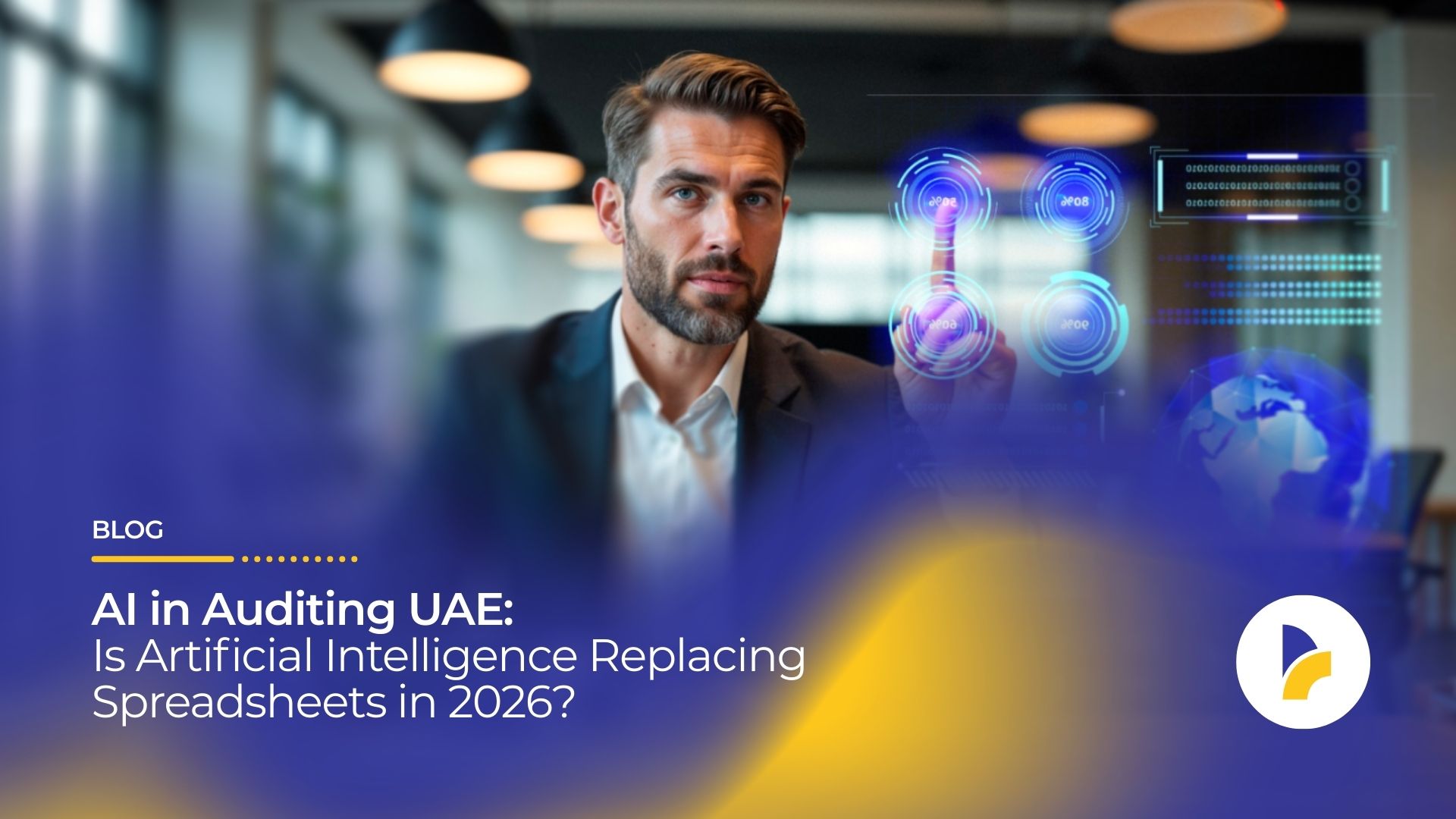
Artificial intelligence is now part of everyday business in the UAE, from cybersecurity and logistics to healthcare. Its role in auditing is growing fast, especially among larger firms. That raises an obvious question: are we finally moving past the spreadsheet era in auditing?
Is AI the future of auditing?
AI is becoming a powerful tool in both internal and external audits. It is not expected to replace human auditors, but it is changing how audits are done by automating repetitive work and improving data analysis. Human auditors will still provide:
- Critical judgement
- Risk interpretation
- Insight and reporting
- Professional scepticism
AI, in turn, makes the work faster and more accurate.
How AI is being built into the audit process
- Audit planning: AI can scan large datasets almost instantly to spot anomalies and high-risk areas, making risk assessment more efficient.
- Journal entry testing: instead of sampling selected entries, AI can test 100% of journal entries and flag irregular transactions.
- Reconciliation automation: tools such as DataSnipper match invoices, check documents and cross-check spreadsheet data automatically, saving hours of manual work.
- Real-time monitoring and alerts: AI systems can raise alerts when financial patterns change or suspicious activity appears.
Benefits of AI in auditing
- Earlier fraud detection: AI picks out unusual transaction patterns across very large datasets.
- Fewer manual errors: automating repetitive tasks reduces the risk of human error.
- Full-population analysis: auditors can review every transaction instead of a limited sample.
- More time for analysis: auditors can move from data processing to interpretation, advice and insight.
- Better compliance support: AI can help with structured documentation and compliance monitoring, provided proper governance is in place, which matters under laws such as the UAE Personal Data Protection Law (PDPL).
Challenges of using AI in auditing
- Regulatory uncertainty: AI governance rules in the UAE are still developing. The PDPL protects personal data, but detailed AI-specific audit rules are still emerging.
- Algorithmic bias: AI can produce biased or opaque results, so auditors must check and challenge what it produces.
- Training investment: firms need to invest in staff skills and digital infrastructure, which can be harder for smaller practices.
- Data privacy: AI tools often process sensitive financial data, so they must comply with UAE privacy law.
- Skills gap: tomorrow’s auditors need both accounting knowledge and data analytics skills.
How auditors can upskill for the AI era
- Follow AI developments: keep up with UAE AI regulation and global auditing standards.
- Learn data analytics basics: understand how AI processes large datasets and finds anomalies.
- Get hands-on with tools: become familiar with DataSnipper and other automation platforms.
- Strengthen advisory skills: as AI takes over routine tasks, interpretation and insight become the auditor’s main value.
UAE data privacy law and AI in auditing
As AI use grows, so does the importance of data protection. The UAE introduced the Personal Data Protection Law (PDPL) in 2021 to regulate how businesses collect, process and store personal data. Its key principles include:
- Businesses need a lawful basis, such as consent, to process personal data
- Individuals have rights to access and correct their data
- Cross-border transfers of data are regulated
AI tools used in audits must meet these requirements, and audit firms need to keep up as AI governance in the UAE develops.
The future of AI in auditing in the UAE
AI will not eliminate auditors. It will make them better. The future of auditing in Dubai and across the UAE is likely to involve:
- Hybrid audit models combining AI and human expertise
- Real-time financial monitoring
- Predictive risk analytics
- Closer regulatory oversight
Firms that invest early in AI and training will have a clear advantage.
Work with expert auditors at Darjiaccounting.ae
At Darjiaccounting.ae we combine modern audit methods with deep regulatory knowledge to deliver accurate, compliant and valuable audit services across the UAE. Our services include:
- Internal and external audits
- Risk advisory and compliance audits
- Accounting and bookkeeping
- Corporate Tax advisory
We keep your business compliant while using technology to work more efficiently. Book a free consultation.
Frequently asked questions
Can AI replace auditors?
No. AI supports automation and data analysis, but human auditors remain essential for judgement, insight and interpretation.
What are the challenges of AI in auditing?
The main challenges are evolving regulation, algorithmic bias, the cost of training and systems, data privacy, and the skills gap between accounting and data analytics.
How is AI used in auditing?
For risk assessment during planning, testing entire populations of journal entries, automating reconciliations and document matching, and monitoring transactions in real time.
What is the role of AI in internal audit?
Internal audit teams use AI for continuous monitoring of controls and transactions. Issues are flagged as they happen instead of months later, so the team can focus on the highest-risk areas.
Can AI be used in external audits?
Yes. External auditors use AI tools to analyse full datasets, test journal entries and match supporting documents. The audit opinion itself remains the auditor’s professional judgement.